Ingun Grimstad Klepp and Tone Skårdal Tobiasson have together given feedback on the JRC document Preparatory study (PS) on textiles for product policy instruments – 3rd Milestone. The object of the Preparatory study is to provide the scientific and technical basis for:
— the future development of the ecodesign requirements for textile products to be defined in a delegated act within the framework of the ESPR;
— the future development of the mandatory EU GPP requirements for textile products within the framework of the ESPR;
— the future revision of the EU Ecolabel criteria for textile products, within the framework of the ESPR and the EU Ecolabel Regulation.
The PS follows the structure prescribed by the Methodology for Ecodesign of Energy-related Products. The JRC has requested feedback in the form of a wide range of specific questions with a combination of fixed answer options and free justifications, as well as more open-ended feedback that must also be anchored in specific chapters of the report. Read the feedback Part 1 here. Read the feedback Part 2 here.
This may certainly have its advantages in building the report on a known methodology, but it also means that the development of the text is not based on the specific problems and potential improvement opportunities that exist in the sector. The form in which the feedback is given makes it difficult to read, unless one reads both the main document which is 600 pages, and the 110 pages of questions that are linked to it at the same time. We have therefore here attempted to summarize our feedback and our main criticisms of the ESPR 3rd milestone.
The main problems in the sector
The volume of textiles has grown rapidly and today the situation is that the textiles cannot be used up, because we have more textiles than we have users. This means that the textiles are thrown away slightly used and increasingly also unused. This can be formulated as the average DoS (Duration of service) is decreasing. In the 3rd milestone, JRC gives a good description of the historical reasons for this, including the demise of the Multi Fibre Arrangement and that “the evolution of fibre production is mainly driven by the increase in production of polyester”.
JRC argues for several possible measures, some of which have been changed from the previous round. Repairability has been removed as a design requirement, and has instead become an information issue. They still emphasize “durability”, but because there is no knowledge of how the measurement methods that exist for this capture real wear and tear in use, they choose a proxy for durability that they call ‘robustness’. This they propose contains various measurable aspects: two that are to be measured (spirality, which is twisting, and dimensional change, which is shrinkage) and four that are to be visually evaluated (including color changes, and surface changes such as pilling) after five washing or equivalent ‘cleaning cycles’. For the first two, there are different values for knitted and woven materials, regardless of what the garment is. They acknowledge that these test values cannot be used to predict Duration of Service.
The second aspect is recycled content and recyclability. There is no emphasis on prioritizing reuse, but it is assumed that a mechanical or chemical recycling industry will be developed. The recyclability of the products should be informed to consumers with a points scale, which, among other things, means that more than 15 percent elastane means the product is not recyclable. They are unsure whether recycled content should only be an information requirement, or also constitute a minimum requirement.
The document also discusses the content of problematic chemicals, but limited to what may be problematic for recycling. Other aspects of chemical content will become a matter for other regulations, which is the argument for leaving this out
It is also considered how the products’ environmental and/or climate impacts should be measured and communicated. Here they refer to PEFCR for A&F, but argue for cutting out fiber formation (LCS1), because different fibers cannot be directly compared. For the manufacturing stage itself, there is a discussion about whether only primary data or also secondary data can be used. They are aware that secondary data – which provides global averages – may be tempting to use if a company’s own data is worse. Whether transport, use and disposal should be included has not been discussed in depth.
The weaknesses of such a perspective
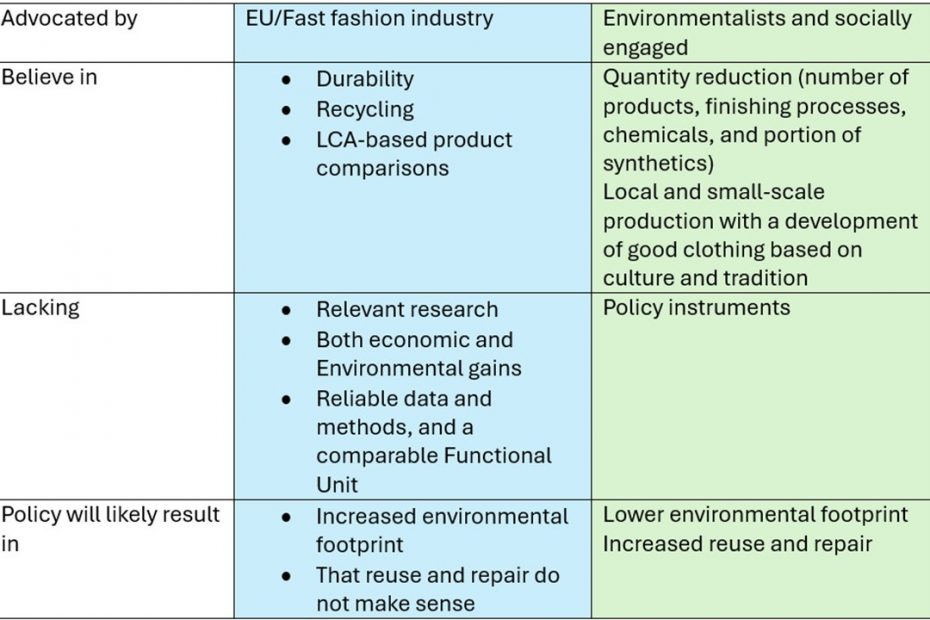
The emphasis on durability (now robustness) remains a weakness, because we do not have knowledge that ensures that more durable or robust products will result in less production (Maldini et al., 2025). The assumption is that more robust products will reduce environmental impacts, but the studies that have been done on durability and that have actually investigated this do not provide evidence for this. The reason is that the textile value chain is not driven by demand, but by supply and marketing – and that people do not buy things to “replace” something. On the contrary, there is a reverse tendency. When something new is bought, something that is already there will be used less or possibly thrown away.
More robust products will therefore be at risk of increasing environmental impact. This is because the products either need more materials (and chemicals) to become stronger. In addition, the synthetic materials will come out best in the chosen tests such as color fastness and surface changes (which are thought to be the same to a large extent, regardless of fiber). The emphasis on recycled content has a similar weakness. What would happen if we actually had a large-scale recycling industry that produced chemically or mechanically recycled fiber? Would current virgin fiber production be less? We are not aware of research that addresses this, but it is known from previous examples that China (which is the dominant producer of polyester) will rather dump prices than reduce production. It is therefore not a given that a new industry will replace what we have, but there is a risk that it will be an add-on. The research that has attempted to calculate the environmental savings in a large-scale European recycling industry also does not show any major savings for either the environment or the climate (Sandin et al., 2023).
Our alternatives
We believe that there is a limit to what can be done through an ecodesign directive at the product level. This is especially true if the measure is to apply to all products and everything is to undergo all the same tests. Among other things, this will burden small and micro-sized businesses disproportionately. The reason for the uncontrolled growth is, as the JRC also documents so well, changes in global trade agreements combined with very low prices for fossil materials. It is therefore a paradox that it is at the product level that this is to be met, and especially when the proposal inadvertently promotes plastic. That said, we understand that regulatory mechanisms that deal with quantity lie outside of the ESPR, which is precisely defined as design changes to the products or information about the products to consumers. Our feedback therefore concerns what is possible within the scope of what this document is about. We show how the growth in quantity makes it increasingly less necessary to have more robust products – they will still be used less and less. We believe that all measures should be assessed against the following questions:
• Will they contribute to favor fossil materials (and thus contribute to growth in quantity)
• Will they contribute to growth in quantity (measured as number or weight)
And by assessment we mean both intended and unintended effects of the measures. Furthermore, we argue for selecting some specific problems for a smaller group of products and solving these, preferably through bans. This will ensure more control over unintended effects, make it more realistic to achieve targets for reductions in environmental and climate footprint (in light of the growth in the sector) and also make the choices politically clearer. The measures proposed by the JRC have low potential also in JRC’s own assessment of them. If something is really to be saved – compared to the growth in the sector – then something has to go. What is to go out should be discussed. Our suggestions for what could be considered to be banned or heavily taxed are, for example:
• Prestressing with finishing chemical and mechanical processes (such as those often done on jeans)
• Mixing elastane into products where stretch is not required (e.g. jeans)
• Large, non-reprovable prints on clothing
• Use of flashing lights, batteries and other electronics (e.g. in sneakers and Christmas sweaters)
• Small plastic products that are easy to lose in nature (e.g. animal socks and sequins)
Measures aimed at recyclability and recycled content could be advantageously introduced (first) for synthetic fibers where it is also easier. It should then be fiber to fiber and not allowed to use recycled plastic bottles, etc. One could, for example, also impose the same requirements for origin information for synthetic fibers as for natural materials. Increasing knowledge that Russian oil and gas are used in Chinese production is interesting in this context.
Some of the same arguments (that, for example, the proportion of plastic in a product should be indicated, as France has introduced), we use in the microplastic discussion. If the spread of microplastics is to decrease, the volume of synthetic textiles must decrease. This is because it is as waste (which is not incinerated) that the spread is greatest. The work to reduce microplastic pollution and the work to stop plasticization and the growth of the sector overall are thus two sides of the same coin.
MALDINI, I., KLEPP, I. G. & LAITALA, K. 2025. The environmental impact of product lifetime extension: a literature review and research agenda. Sustainable Production and Consumption, 56, 561-578.
SANDIN, G., LIDFELDT, M. & NELLSTRÖM, M. 2023. Does large-scale textile recycling in Europe reduce climate impact? A consequential life cycle assessment. IVL Swedish Environmental Research Institute.