Skip to content

Increasing repair of household appliances, mobile phones and clothing: Experiences from consumers and the repair industry

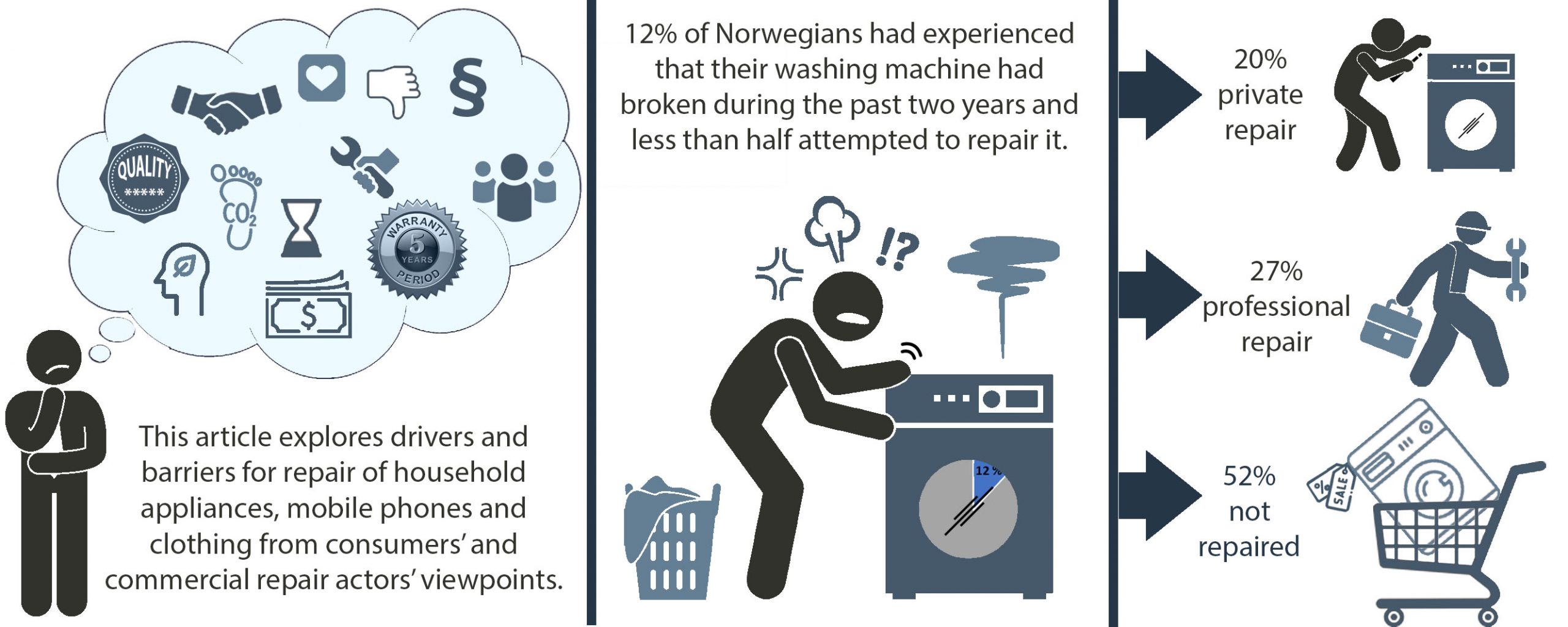
Increasing product lifespans is one of the most effective environmental strategies and therefore repair is a part of the circular economy approach that aims to keep products and materials longer in use. This article explores drivers and barriers for repair from consumers’ and commercial repair actors view-points, in order to understand how the repair rates of household appliances, mobile phones and clothing could be increased.

The study is based on a consumer survey of 1196 respondents in Norway, and 15 qualitative interviews with actors in the commercial repair industry working with repairs of household consumer goods. A surprisingly high share of repairs was conducted by consumers themselves. The main barrier is the consistently low price of new products, and often of poor quality, which contributes to low profitability in repair work for businesses and low motivation from consumers. Furthermore, access to competent personnel is a major challenge for the repair industry, a need which is expected to increase in the coming years.

KRUS final report: Enhancing local value chains in Norway

From its initiation in 2015 to the end in 2019, KRUS had two goals: to improve the market for and the value of Norwegian wool, and survey the opportunities for local production in a move towards a goal of sustainability in the fashion sector. On a larger scale, KRUS has looked at how we can re-establish an understanding of the connection between the raw material and the finished product within the textile industry and among consumers. It is critical to understand this connection, both to ensure quality products and to reach the market potential for Norwegian wool.