Skip to content

Laundry Care Regimes: Do the Practices of Keeping Clothes Clean Have Different Environmental Impacts Based on the Fibre Content?

  • by

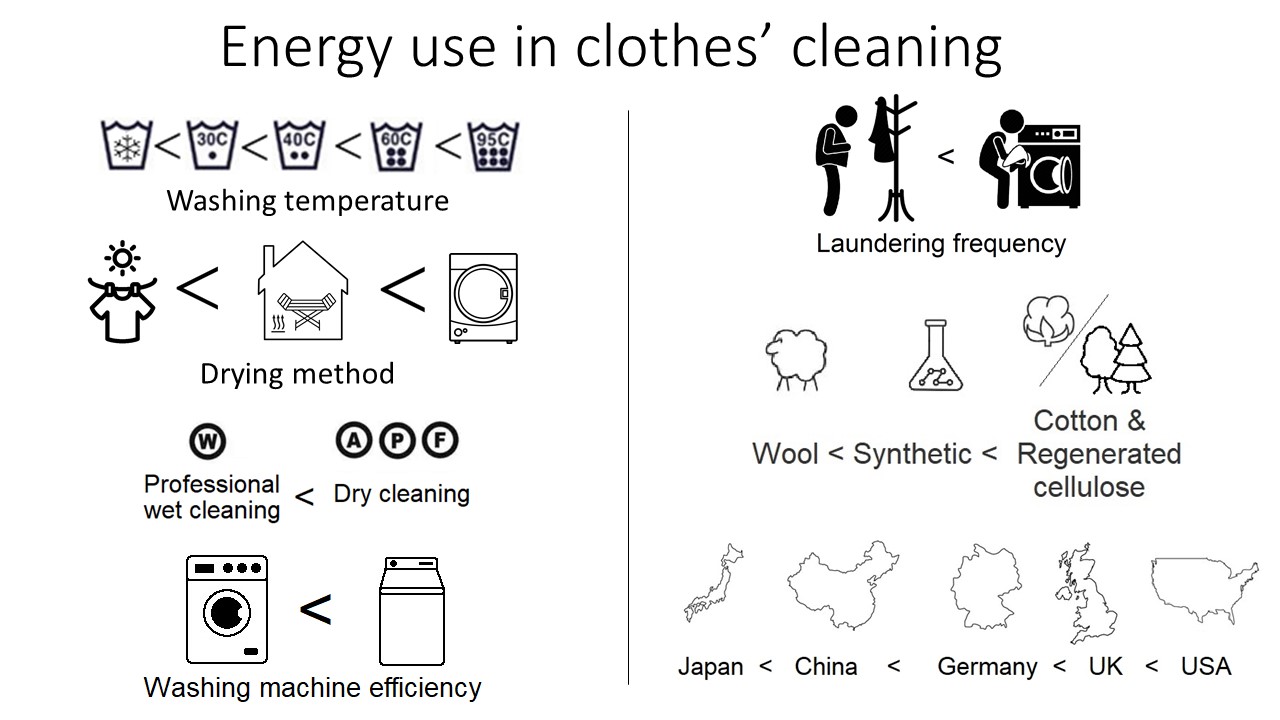
Clothing maintenance is necessary for keeping clothing and textiles functional and socially acceptable, but it has environmental consequences due to the use of energy, water and chemicals. This article discusses whether clothes made of different materials are cleaned in different ways and have different environmental impacts. It fills a knowledge gap needed in environmental assessments that evaluate the impacts based on the function of a garment by giving detailed information on the use phase. The article is based on a quantitative wardrobe survey and qualitative laundry diary data from China, Germany, Japan, the UK and the USA.

Environmental impacts associated with the production, use, and end-of-life of a woollen garment

The textiles industry is a substantial contributor to environmental impacts through the production, processing, use, and end-of-life of garments. Wool is a high value, natural, and renewable fibre that is used to produce a wide range of garments, from active leisure wear to formal wear, and represents a small segment of the global fashion industry. Woollen garments are produced by long, global value chains extending from the production of ‘greasy’ wool on sheep farms, through processing to garment make-up, retail, consumer use, and end-of-life. To date, there have been limited life cycle assessment (LCA) studies on the environmental impacts of the full supply chain or use phase of garments, with the majority of wool LCA studies focusing on a segment of the supply chain. This study aimed to address this knowledge gap via a cradle-to-grave LCA of a woollen garment.

Potential for environmental improvements in laundering

  • by

Life cycle assessment studies on clothes, detergents and washing machines show that the use period is usually the most energy-demanding period during these products’ life cycle, even higher than production or transportation phases. Laundering practices are constantly changing and influenced by social, cultural and moral norms. Even though the technologies in clothes cleaning have improved greatly, the length of time that consumers use for washing clothes has not been reduced. We own more clothing and wash it more frequently. This increased amount of washing counteracts the technological improvements in laundry.

This paper discussed the options of changing consumer habits in clothing maintenance to a more environmentally friendly direction and attempts to evaluate which changes would be the most feasible and efficient. Laboratory trial results on washing were compared with earlier research on consumers’ washing habits. Laboratory-based tests measuring cleaning effect, energy and water consumption were performed in order to evaluate the consequences of changing the washing temperature, filling grade, detergent dosage or drying method. The cleaning effect tests showed that today’s detergents are suitable for low temperature washing, and by selecting an efficient detergent, the cleaning result can be better at 30°C than with a less efficient detergent at 40°C. When washing only slightly soiled textiles or small loads of laundry, the detergent amount can be reduced. Many textiles changed more in colour or strength if they were washed at higher temperature(60°C) than at lower temperature (40°C or below). Tumble-dried textiles shrank more than line dried. These facts can be used to motivate consumers to change behaviour in order to reduce the environmental impacts of textile maintenance.