Skip to content

Global differences in consumer practices affect clothing lifespans

Most studies of clothing and related habits are carried out within a country. However, apparel production and sales are a highly globalized industry, with many of the same large chains operating worldwide. It is thus quite possible that the use of the same mass-produced clothing differs between various geographical areas. Based on a practice theoretical approach, we have studied differences in consumption, use and disposal of clothes in different countries that may affect the lifespan of apparel.

The paper is based on an international survey in five countries with large apparel markets: China, Germany, Japan, UK and the USA. 200 respondents from each country answered to a comprehensive web-based survey on their wardrobe content. We found differences in practices that could affect the lifespans of clothing in these five countries. At the same time, we find many similarities. For clothing acquisition, buying new items dominates in all the five markets, and washing machines contribute to the main chore of keeping clothes clean. Home production and second-hand clothes constitute a very small part of clothing consumption in all five countries. Many respondents showed low sewing skills, and repair activities were done irregularly. Thus, many of the challenges to increasing the lifespans of clothing are similar for all the five countries. At the same time, there are significant differences. These differences open up for the possibility to learn «best practice» by studying the countries and transferring knowledge between regions. When defining use phase in LCA and other sustainability tools, it must be taken into account that despite the fact that clothing is a global industry, consumption is part of local practice.


What Affects Garment Lifespans? International Clothing Practices Based on a Wardrobe Survey in China, Germany, Japan, the UK, and the USA

Increasing the length of clothing lifespans is crucial for reducing the total environmental impacts. This article discusses which factors contribute to the length of garment lifespans by studying how long garments are used, how many times they are worn, and by how many users. The analysis is based on quantitative wardrobe survey data from China, Germany, Japan, the UK, and the USA. Variables were divided into four blocks related respectively to the garment, user, garment use, and clothing practices, and used in two hierarchical multiple regressions and two binary logistic regressions.

The models explain between 11% and 43% of the variation in clothing lifespans. The garment use block was most indicative for the number of wears, while garment related properties contribute most to variation in the number of users. For lifespans measured in years, all four aspects were almost equally important. Some aspects that affect the lifespans of clothing cannot be easily changed (e.g., the consumer’s income, nationality, and age) but they can be used to identify where different measures can have the largest benefits. Several of the other conditions that affect lifespans can be changed (e.g., garment price and attitudes towards fashion) through quality management, marketing strategies, information, and improved consumer policies.

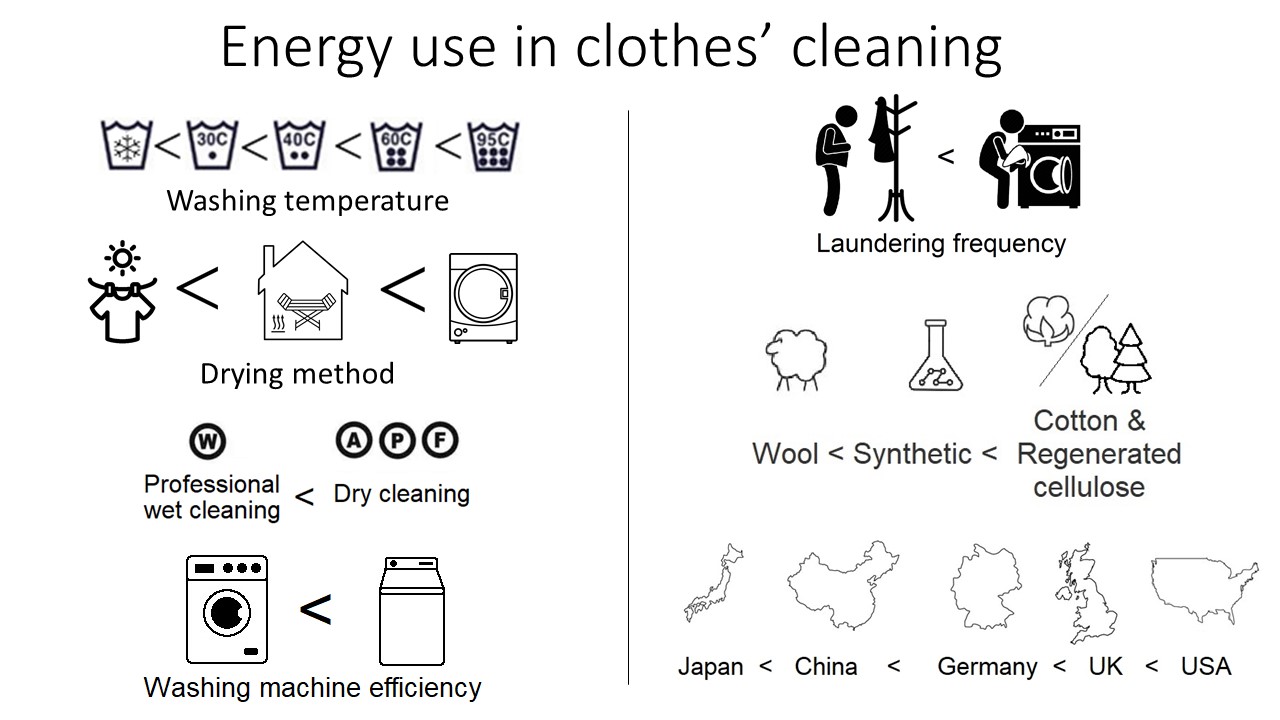
Laundry Care Regimes: Do the Practices of Keeping Clothes Clean Have Different Environmental Impacts Based on the Fibre Content?

Clothing maintenance is necessary for keeping clothing and textiles functional and socially acceptable, but it has environmental consequences due to the use of energy, water and chemicals. This article discusses whether clothes made of different materials are cleaned in different ways and have different environmental impacts. It fills a knowledge gap needed in environmental assessments that evaluate the impacts based on the function of a garment by giving detailed information on the use phase. The article is based on a quantitative wardrobe survey and qualitative laundry diary data from China, Germany, Japan, the UK and the USA.

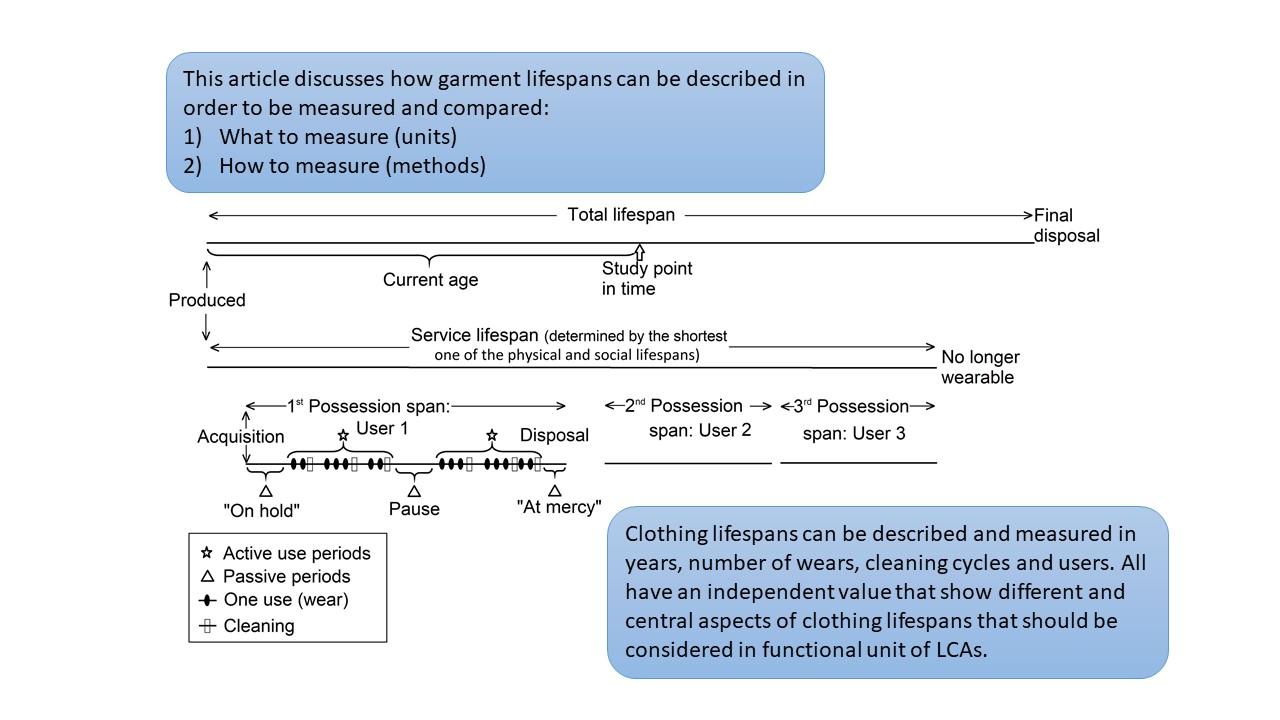
Clothing Lifespans: What Should Be Measured and How

Increasing the use of each product, most often called longer lifespans, is an effective environmental strategy. This article discusses how garment lifespans can be described in order to be measured and compared. It answers two sub-questions: (1) what to measure (units), and (2) how to measure (methods). We introduce and define terms related to clothing lifespans and contribute to discussions about an appropriate functional unit for garments in life cycle assessments (LCA) and other environmental accounting tools. We use a global wardrobe survey to exemplify the units and methods.

Clothing lifespans can be described and measured in years, the number of wears, cleaning cycles, and users. All have an independent value that show different and central aspects of clothing lifespans. A functional unit for LCAs should emphasise both the number of wears for all users as well as the service lifespan in years. Number of wears is the best measure for regular clothing, while number of years is most suited for occasion wear, because it is important to account for the need of more garments to cover all the relevant occasions during a specified time period. It is possible to study lifespan via carefully constructed surveys, providing key data relating to actual garment use.

Environmental impacts associated with the production, use, and end-of-life of a woollen garment

The textiles industry is a substantial contributor to environmental impacts through the production, processing, use, and end-of-life of garments. Wool is a high value, natural, and renewable fibre that is used to produce a wide range of garments, from active leisure wear to formal wear, and represents a small segment of the global fashion industry. Woollen garments are produced by long, global value chains extending from the production of ‘greasy’ wool on sheep farms, through processing to garment make-up, retail, consumer use, and end-of-life. To date, there have been limited life cycle assessment (LCA) studies on the environmental impacts of the full supply chain or use phase of garments, with the majority of wool LCA studies focusing on a segment of the supply chain. This study aimed to address this knowledge gap via a cradle-to-grave LCA of a woollen garment.

KRUS final report: Enhancing local value chains in Norway

From its initiation in 2015 to the end in 2019, KRUS had two goals: to improve the market for and the value of Norwegian wool, and survey the opportunities for local production in a move towards a goal of sustainability in the fashion sector. On a larger scale, KRUS has looked at how we can re-establish an understanding of the connection between the raw material and the finished product within the textile industry and among consumers. It is critical to understand this connection, both to ensure quality products and to reach the market potential for Norwegian wool.

Microfibres from apparel and home textiles: Prospects for including microplastics in environmental sustainability assessment

Textiles release fibres to the environment during production, use, and at end-of-life disposal. Approximately two-thirds of all textile items are now synthetic, dominated by petroleum-based organic polymers such as polyester,polyamide and acrylic. Plastic microfibres (b5 mm) and nanofibres (b100 nm) have been identified in ecosystems in all regions of the globe and have been estimated to comprise up to 35% of primary microplastics in marine environments, a major proportion of microplastics on coastal shorelines and to persist for decades in soils treated with sludge from waste water treatment plants.

In this paper we present a critical review of factors affecting the release from fabrics of microfibres, and of the risks for impacts on ecological systems and potentially on human health. This review is used as a basis for exploring the potential to include a metric for microplastic pollution in tools that have been developed to quantify the environmental performance of apparel and home textiles. We conclude that the simple metric of mass or number of microfibres released combined with data on their persistence in the environment, could provide a useful interim mid-point indicator in sustainability assessment tools to support monitoring and mitigation strategies for microplastic pollution. Identified priority research areas include: (1) Standardised analytical methods for textile microfibres and nanofibres; (2) Ecotoxicological studies using environmentally realistic concentrations; (3) Studies tracking the fate of microplastics in complex food webs; and (4) Refined indicators for microfibre impacts in apparel and home textile sustainability assessment tools.

Care and production of clothing in Norwegian homes: Environmental implications of mending and making practices

Mending, re-design, and altering are alternatives for prolonging the use period of clothing. It is a common assumption that nobody mends clothing anymore in Western societies. This paper studies Norwegian consumers’ clothing mending and making practices. We ask how common the different mending and making activities are, has this changed during the past several years, who are the clothing menders and makers, and further, are these practices related to consumers environmental opinions?

We build on three quantitative surveys in Norway from 2010, 2011, and 2017. Many consumers do mend their clothing at least occasionally, especially the simpler tasks, such as sewing on a button and fixing an unravelled seam. Women and the elderly are more active in making and mending, whereas the young are a bit more likely to make something new out of old clothing. The mending activities were correlated with respondents’ environmental opinions. Mending clothes is more common than is usually assumed. Knowledge of current practices and barriers for clothing mending enables us to recommend measures that can potentially increase the use time of clothing. These results can be beneficial in clothing design, home economics, and crafts education as well as understanding consumer behavior and making policies that aim at environmental improvements within clothing consumption.

Does Use Matter? Comparison of Environmental Impacts of Clothing Based on Fiber Type

Several tools have been developed to compare the environmental impact of textiles. The most widely used are Higg Materials Sustainability Index (MSI) and MADE-BY Fiber Benchmark. They use data from production to evaluate the environmental impacts of textiles differentiated by fiber type. The use phase is excluded from both tools. This article discusses whether there is evidence that the use of textiles differs systematically between different fiber types and examines the consequences of comparing the environmental impacts of clothing based on differences in production of fibers alone without including differences in their use.

The empirical material in this paper is based on analysis of rating tools and a literature review on clothing use. It shows that fiber content contributes to the way consumers take care of and use their clothing. When use is omitted, major environmental problems associated with this stage, such as spread of microplastics, are also excluded. This one-sided focus on material production impacts also excludes the importance of product lifespans, quality, and functionality. The consequence is that short-lived disposable products are equated with durable products. Comparing dissimilar garments will not help consumers to make choices that will reduce the environmental burden of clothing. We need an informed discussion on how to use all materials in the most environmentally sustainable way possible.

A Note from the Editors of Fashion Practice

The general editors of Fashion Practice, Sandy Black and Marilyn Delong, would like to thank our guest editors Kate Fletcher and Ingun Grimstad Klepp for their work in developing this Special Issue on Localism and Fashion. With its focus on localism as a movement concerned with generating knowledge for change, we see an emerging concept for fashion. This reaches beyond a more familiar territory, where the notion of localism may be concentrated on marketing a place, country or region through the fiber and garments made there—for example, see the previous special issue “Fashion Made in Italy” (2014, Volume 6 Issue 2). We view this current edition as the beginning of a stimulating debate on the topic of localism.

Nisseluelandet—The Impact of Local Clothes for the Survival of a Textile Industry in Norway

The article discusses the importance of local clothing for the survival of the Norwegian textile industry. It draws upon stakeholder interviews, as well as desktop research. Local clothes are discussed as they are understood by consumers, as knitted sweaters, bunads (Norwegian national costumes), and home-made clothing. The review shows how these products, and especially the materials used in their production, have been crucial for the continued existence of the Norwegian textile industry. We argue that the concept “local clothes” can contribute to showcasing resources outside the global “fast fashion” manufacturing system.

Motivations for and against second-hand clothing acquisition

One of the possibilities consumers have for more sustainable clothing acquisition is to select pre-owned products. This article explores consumers’ motivations for clothing reuse: why they choose or do not choose to acquire second-hand clothing. First, a taxonomy of motivation categories based on previous studies is presented. This demonstrates that similar properties can be used as arguments both for and against acquisition of second-hand clothing. An analysis of a representative sample of Norwegian consumers shows that both environmental and economic reasons are important for those who take part in informal clothing circulation. Uniqueness and style are more important for those who buy second-hand clothing.

Those who do not take part in any of the forms of acquisition of used clothing, use vague and open justifications, as well as contextual aspects; hygiene, health and intimacy. Previous studies have mostly been based on how clothing is reused as part of a market exchange, and therefore the motives have been embedded with a rational choice understanding of consumption. Studies of the private exchange of clothing should also address additional reasons such as routinized practices and established rituals, family ties, feelings, friendship and love. The article concludes with an invitation for further research to explore several possible motivations that are more relevant for private circulation of clothes.