Skip to content

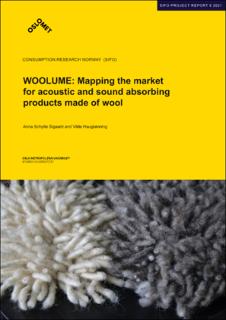
WOOLUME: Mapping the market for acoustic and sound absorbing products made of wool

This report is the first deliverable from work package 2 of the WOOLUME project. The main goal of WOOLUME is to
explore different ways of using wool from Polish Mountain Sheep to achieve better utilisation of resources and value
creation. The aim of the report has been to map the market for acoustic and sound absorbing products made of wool to
examine the potential to introduce coarse wool as a material.

Clothing longevity: the relationship between the number of users, how long and how many times garments are used

Kirsi Laitala & Ingun Grimstad Klepp Abstract Reuse of clothing is a central strategy in circular economy for keeping the resources and materials in the loop longer. This paper studies the correlation between clothing service… Clothing longevity: the relationship between the number of users, how long and how many times garments are used

Reducing environmental impacts from garments through best practice garment use and care, using the example of a Merino wool sweater

Garment production and use generate substantial environmental impacts, and the care and use are key determinants of cradle-to-grave impacts. The present study investigated the potential to reduce environmental impacts by applying best practices for garment care combined with increased garment use. A wool sweater is used as an example because wool garments have particular attributes that favour reduced environmental impacts in the use phase.

A Louse in Court: Norwegian Knitted Sweaters with ‘Lus’ on Big-Time Criminals

Early one morning in 2008 I was sitting in make-up for a Norwegian television show and felt the trained hands of the make-up smooth out my face with paint. It wasn’t the first time I’d been there. With a population of 5 million there are not many clothing researchers to choose between in Norway, and with plenty of weather and outdoor activities, clothes are important. Questions such as how to dress children for physical activities outdoors are equally relevant every autumn and before every winter vacation and every Easter, when Norwegians go to their cabins, and the ideal is to spend as much time as possible outdoors. I have talked about the choice between wool and synthetic fibres and also about traditional Norwegian knitwear, but this time the subject was somewhat different.

The Norwegian Islamist Arfan Bhattis stood, as the first person in Norway to be accused of violating a new terror clause in the Penal Code. The striking thing for the Norwegian press was that he appeared in court in a Norwegian knitted sweater, a so-called lusekofte [lit: lice jacket], and he wasn’t the first. Before him, the accused in the biggest robbery in Norwegian history and the accused in the most discussed triple homicide had dressed in the lusekofte in court.
Uniformity Without Uniforms: Dressing School Children in Norway

This chapter discusses the relationship between Norwegian schools’ ideals of equality and the way in which school clothes are regulated. Interviews with a teacher in a transitional language learning group for newly arrived immigrant children, as well as with children and parents in immigrant families, are used to discuss whether school clothes inhibit or promote integration. The material shows great willingness of children to dress like the others, as well as understanding that clothing consumption is essential for integration in school, and thus society. At the same time, this is not easily achievable either economically, culturally or practically. Little is done to make Norwegian schools inclusive in this field of consumption.

Dressing a Demanding Body to Fit In: Clean and Decent with Ostomy or Chronic Skin Disease

This article discusses what kind of strategies people with a stoma or various chronic skin conditions, such as psoriasis oratopic dermatitis, use to find clothes that fit and enable them to fit in. Based on qualitative interviews in Norway, we study how they manage to dress with a demanding body, a poor market and limited economic resources. This includes describing how purchases take place, which clothes fit, how much clothing is needed, and which laundry practices are used. Their main strategy was to reduce the requirements for their own appearance rather than to cleanliness and body odours. If they were unable to appear appropriately dressed, as a minimum odourless and stain-free, they reduced their participation in social life.

Woolbed

Ingun Grimstad Klepp, Kirsi Laitala and Tone Skårdal Tobiasson Summary We have studied Norwegian and Swedish consumers’ experiences and perceptions related to using wool in bedlinen and sleepwear. We have used a variety of research… Woolbed

Deviant bodies and suitable clothes

Suitable clothes are clothes that make the body socially accepted. The theme of this article concerns what people with deviant bodies do when suitable clothes are difficult to find; clothes that make their bodies fit in in everyday social contexts. Based on interviews with Norwegian men and women, the focus is on those people who have bodies that deviate from the present Western bodily ideals of thinness, fitness and no deviances.

The article relates the interviews to research in two different fields: disability studies and fashion studies. A primary focus is on the relationship between acceptance of one’s own body—“making the best out of it,”—and respondents’ different strategies for coping with the situation. The final discussion addresses the relationship between the clothes market and deviant bodies. Focusing on a group of people with special problems related to clothes might bring forth new knowledge in general. In addition, a change in the status of the market may have positive effects for those already excluded from this market.