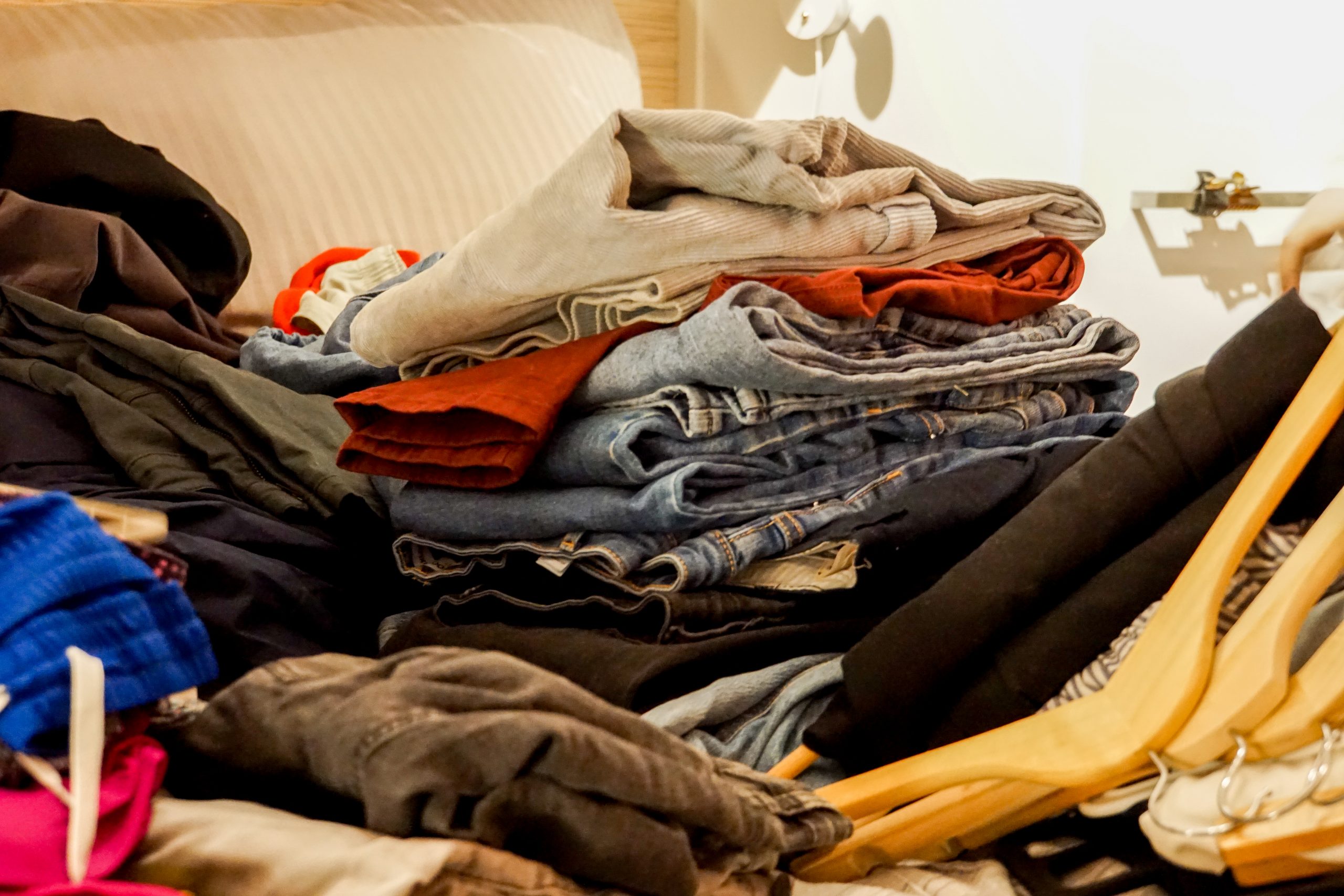
More than enough clothes: a social practice-oriented study of gender and clothing accumulation
Author: Vilde Haugrønning
Author: Vilde Haugrønning
Authors: Tone Rasch, Ingrid Haugsrud, Kirsi Laitala and Atle Wehn Hegnes Abstract Consumer practices related to how we use and take care of products have changed throughout history. Especially within clothing consumption, the changes have… The devaluation of stockings
Early one morning in 2008 I was sitting in make-up for a Norwegian television show and felt the trained hands of the make-up smooth out my face with paint. It wasn’t the first time I’d been there. With a population of 5 million there are not many clothing researchers to choose between in Norway, and with plenty of weather and outdoor activities, clothes are important. Questions such as how to dress children for physical activities outdoors are equally relevant every autumn and before every winter vacation and every Easter, when Norwegians go to their cabins, and the ideal is to spend as much time as possible outdoors. I have talked about the choice between wool and synthetic fibres and also about traditional Norwegian knitwear, but this time the subject was somewhat different.
The Norwegian Islamist Arfan Bhattis stood, as the first person in Norway to be accused of violating a new terror clause in the Penal Code. The striking thing for the Norwegian press was that he appeared in court in a Norwegian knitted sweater, a so-called lusekofte [lit: lice jacket], and he wasn’t the first. Before him, the accused in the biggest robbery in Norwegian history and the accused in the most discussed triple homicide had dressed in the lusekofte in court.
This chapter discusses the relationship between Norwegian schools’ ideals of equality and the way in which school clothes are regulated. Interviews with a teacher in a transitional language learning group for newly arrived immigrant children, as well as with children and parents in immigrant families, are used to discuss whether school clothes inhibit or promote integration. The material shows great willingness of children to dress like the others, as well as understanding that clothing consumption is essential for integration in school, and thus society. At the same time, this is not easily achievable either economically, culturally or practically. Little is done to make Norwegian schools inclusive in this field of consumption.
This article discusses what kind of strategies people with a stoma or various chronic skin conditions, such as psoriasis oratopic dermatitis, use to find clothes that fit and enable them to fit in. Based on qualitative interviews in Norway, we study how they manage to dress with a demanding body, a poor market and limited economic resources. This includes describing how purchases take place, which clothes fit, how much clothing is needed, and which laundry practices are used. Their main strategy was to reduce the requirements for their own appearance rather than to cleanliness and body odours. If they were unable to appear appropriately dressed, as a minimum odourless and stain-free, they reduced their participation in social life.
Suitable clothes are clothes that make the body socially accepted. The theme of this article concerns what people with deviant bodies do when suitable clothes are difficult to find; clothes that make their bodies fit in in everyday social contexts. Based on interviews with Norwegian men and women, the focus is on those people who have bodies that deviate from the present Western bodily ideals of thinness, fitness and no deviances.
The article relates the interviews to research in two different fields: disability studies and fashion studies. A primary focus is on the relationship between acceptance of one’s own body—“making the best out of it,”—and respondents’ different strategies for coping with the situation. The final discussion addresses the relationship between the clothes market and deviant bodies. Focusing on a group of people with special problems related to clothes might bring forth new knowledge in general. In addition, a change in the status of the market may have positive effects for those already excluded from this market.
“Patched, louse-ridden, tattered—clean, beautiful, gem.” As children we recited this rhyme in Norwegian: “Lappete, lusete, fillete—ren, pen, edelsten,” as we picked petal after petal from a daisy. All the words can be understood as descriptions of the child’s future clothes. Clean is the turning point in the rhyme. Clean is thus seen as the first step on the way towards the gem, and it conveys here the same meaning as in the saying “whole and clean is the greatest finery.” Both emphasize clean clothes as crucial to the judgment of a person’s appearance. In the world of fashion it has been alleged that “anything goes.” This is probably true if we restrict “anything” to small variations in the look, decor, color, and style of clothes. However, our way of dressing also depends on more absolute norms.
This article explores the norms that deal with the relationship between clean and dirty clothes. Despite the fact that there is abundant research on cleanliness and laundering on the one hand, and clothes and clothes habits on the other, there are few points of intersection between the two fields. The article is an attempt at seeing these two themes in conjunction. It investigates how clothes, by being kept clean, make bodies socially acceptable. The article looks at how the demand for cleanliness varies in relation to age, gender, and class, and compares these demands to what we know about decency.
Today’s clothing industry is based on a system where clothes are made in ready-to-wear sizes and meant to fit most people. Studies have pointed out that consumers are discontent with the use of these systems: size designations are not accurate enough to find clothing that fits, and different sizes are poorly available. This article discusses in depth who these consumers are, and which consumer groups are the most dissatisfied with today’s sizing systems. Results are based on a web survey where 2834 Nordic consumers responded, complemented with eight in-depth interviews, market analysis on clothing sizes and in-store trouser size measurements.
Results indicate that higher shares of the consumers who have a body out of touch with the existing beauty ideals express discontentment with the sizing systems and the poor selection available. In particular, large women, very large men, and thin, short men are those who experience less priority in clothing stores and have more difficulties in finding clothes that fit. Consumers tend to blame themselves when the clothes do not fit their bodies, while our study points out that the industry is to blame as they do not produce clothing for all customers.
This article discusses the similarities and differences in how women in two different stages of life describe the relationship between fashion and age. The analytical approach is basically discursive, based on Norwegian teenage girls’ and adult women’s verbal accounts of clothing and clothing practices in conversational interviews undertaken in the late 1990s.
Prevailing discourses as to what represents a breach of clothing conventions are to be found in the ways young girls and grown women talk about clothes. When clothes are used in accordance with conventions and norms, they are not noticed much. However, when clothes are used in a way that differs from the norm, this can attract attention and provoke reactions. By comparing narratives of clothing provided by respondents of the same sex and approximately the same class background but of different ages, we gain access to material that is particularly well suited to illustrate the significance of age in conventions governing clothing and fashion.