Skip to content

Textile Cleaning and Odour Removal

  • by

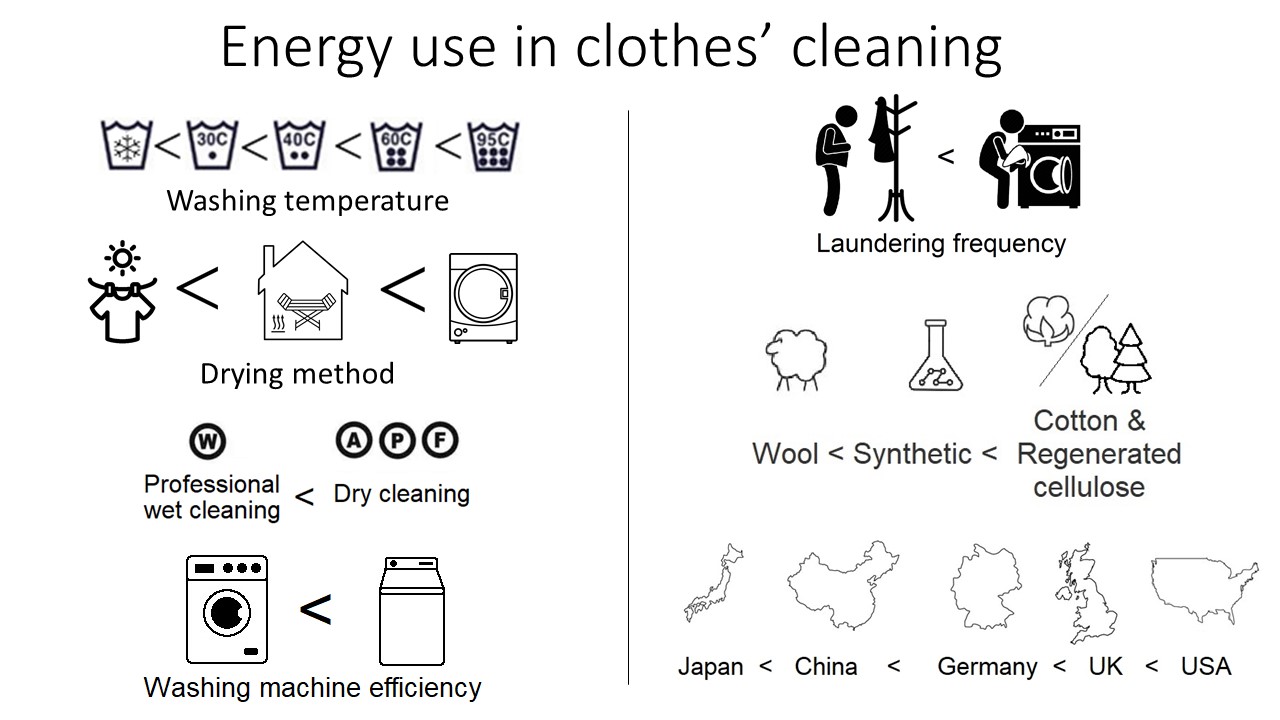
Consumers’ textile care practices today are characterized by frequent laundering. The importance of the removal of odours has increased, especially the smell of sweat. This chapter summarizes knowledge about removing odour from textiles.
The Consumer Perception of Odour

Human olfaction sense is one of the highly underestimated senses since historical times. Fortunately, this has changed in recent times, as the perception of odour or scent by people has received increasing attention through several research works from different scientific disciplines.

Durable or cheap? Parents’ acquisition of children’s clothing

Parents are faced with a plurality of choices and concerns when it comes to the acquisition of clothing for their children. This paper explores how parents employ longevity in consumption of children’s clothing from a practice-oriented perspective. The material consists of 6 focus groups with 40 parents who have at least one child under the age of 18. The aim of the groups was to establish children’s clothing needs: how many they need of each garment, how long parents expect the garment to last and what they understand as quality in clothing.

The analysis shows that parents mainly opt for an ‘one or the other’ strategy; they choose what they understand as quality, often affiliated with specific brands, and accept paying more for the garment, or they mainly choose based on low prices, and expect less of the garment. Quality is evaluated based on the garments’ durability and function. More specifically, the parents measure the service lifetime of a garment based on the number of seasons it lasts, either in terms of wear and tear or the child growing out of it. The expected lifetime is defined by uncertain sources, from their own and friends’ experiences, and their desire to justify their own choices as well as routinised practices.

Consumer practices for extending the social lifetimes of sofas and clothing

Consumers play an essential role in efforts to extend product lifetimes (PL) and consumers’ practices can determine how long and active lives products get. Applying the framework of Social Practice Theory, this paper argues that in order to suggest changes to how consumers can contribute to longer product lifespans, research needs to focus on consumer practices. The data material consists of 4 focus group interviews with 38 participants about household goods and 29 semi-structured interviews about clothing.

Previous research shows that consumers’ expectations of product lifetime has decreased, while satisfaction with products is relatively high, which may indicate that product break down and/or replacement is more accepted. Therefore, we argue, it is necessary to focus on social lifespans. Our findings show that products such as clothing and sofas often go out of use or are disposed of before their physical lifespan ends, and it is more common to donate or sell old clothing and sofas than buying the products second hand. There are a number of routinised practices, such as disposal of functional items, that are considered normal, which leads to less reflexivity of seemingly unsustainable practices.

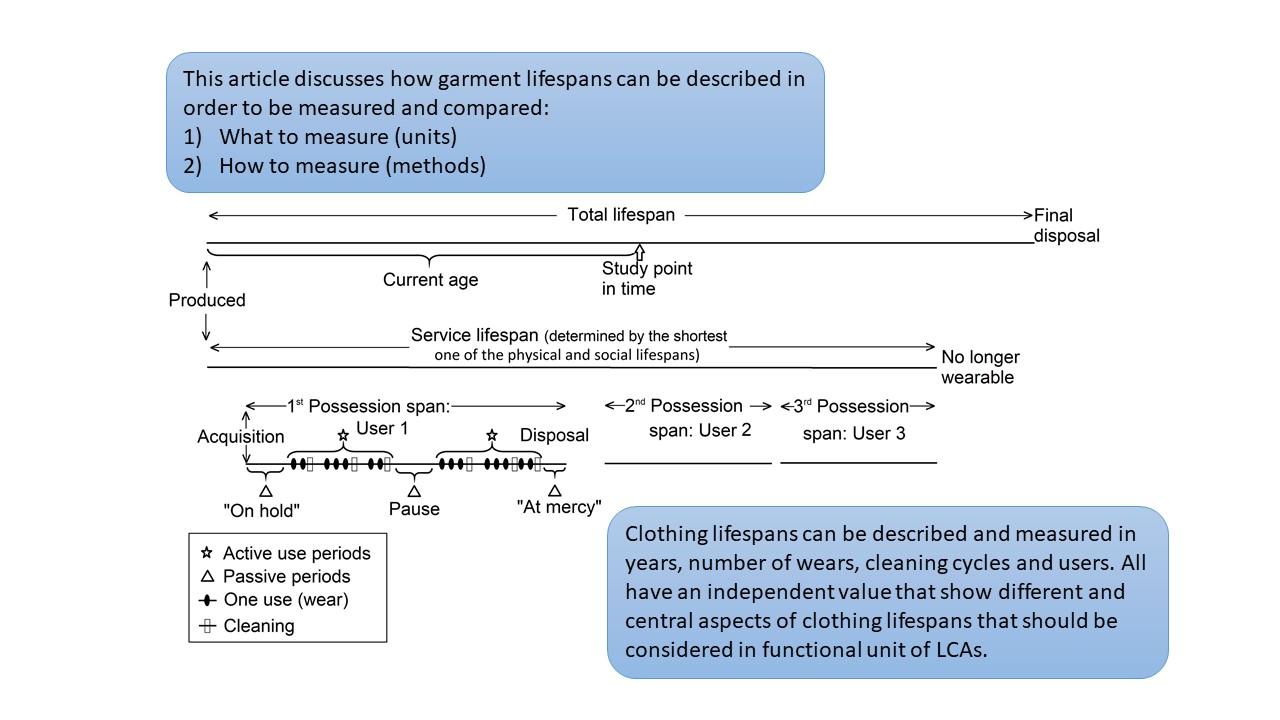
Reducing environmental impacts from garments through best practice garment use and care, using the example of a Merino wool sweater

Garment production and use generate substantial environmental impacts, and the care and use are key determinants of cradle-to-grave impacts. The present study investigated the potential to reduce environmental impacts by applying best practices for garment care combined with increased garment use. A wool sweater is used as an example because wool garments have particular attributes that favour reduced environmental impacts in the use phase.

Increasing repair of household appliances, mobile phones and clothing: Experiences from consumers and the repair industry

  • by

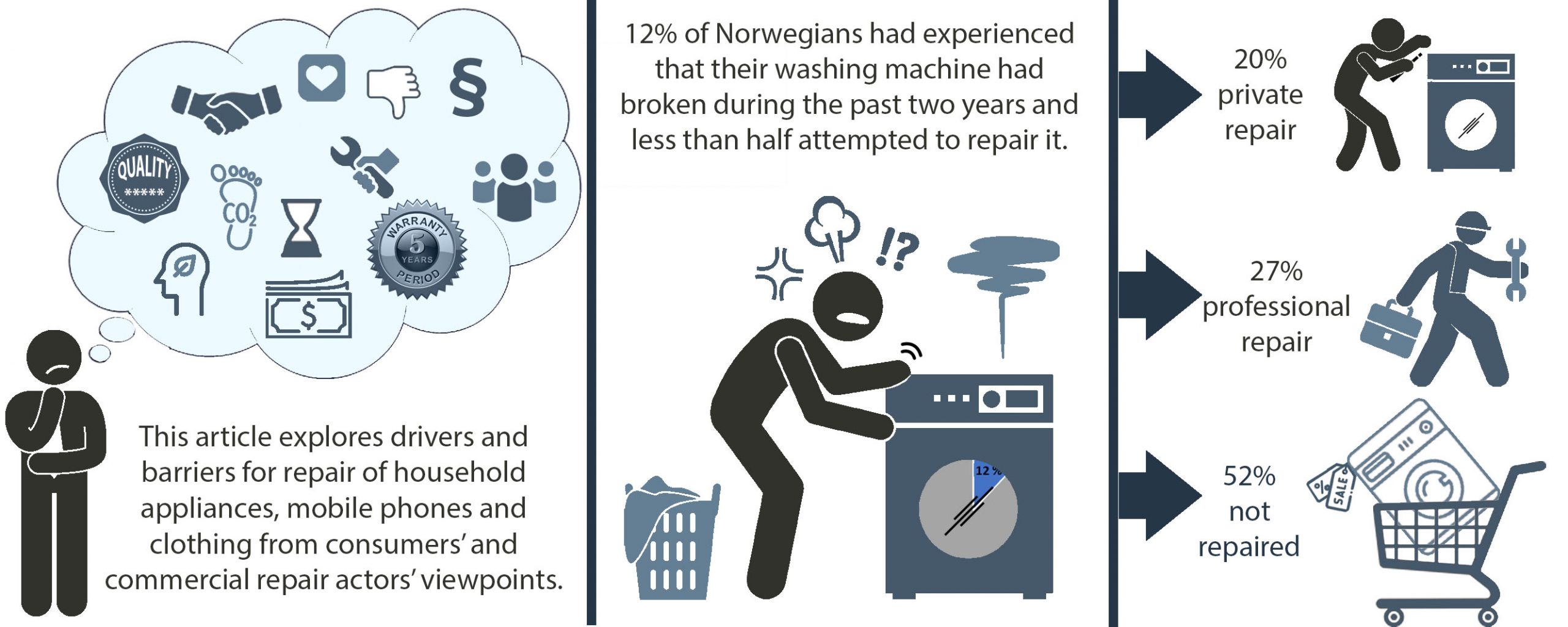
Increasing product lifespans is one of the most effective environmental strategies and therefore repair is a part of the circular economy approach that aims to keep products and materials longer in use. This article explores drivers and barriers for repair from consumers’ and commercial repair actors view-points, in order to understand how the repair rates of household appliances, mobile phones and clothing could be increased.

The study is based on a consumer survey of 1196 respondents in Norway, and 15 qualitative interviews with actors in the commercial repair industry working with repairs of household consumer goods. A surprisingly high share of repairs was conducted by consumers themselves. The main barrier is the consistently low price of new products, and often of poor quality, which contributes to low profitability in repair work for businesses and low motivation from consumers. Furthermore, access to competent personnel is a major challenge for the repair industry, a need which is expected to increase in the coming years.

Global differences in consumer practices affect clothing lifespans

  • by


Most studies of clothing and related habits are carried out within a country. However, apparel production and sales are a highly globalized industry, with many of the same large chains operating worldwide. It is thus quite possible that the use of the same mass-produced clothing differs between various geographical areas. Based on a practice theoretical approach, we have studied differences in consumption, use and disposal of clothes in different countries that may affect the lifespan of apparel.

The paper is based on an international survey in five countries with large apparel markets: China, Germany, Japan, UK and the USA. 200 respondents from each country answered to a comprehensive web-based survey on their wardrobe content. We found differences in practices that could affect the lifespans of clothing in these five countries. At the same time, we find many similarities. For clothing acquisition, buying new items dominates in all the five markets, and washing machines contribute to the main chore of keeping clothes clean. Home production and second-hand clothes constitute a very small part of clothing consumption in all five countries. Many respondents showed low sewing skills, and repair activities were done irregularly. Thus, many of the challenges to increasing the lifespans of clothing are similar for all the five countries. At the same time, there are significant differences. These differences open up for the possibility to learn «best practice» by studying the countries and transferring knowledge between regions. When defining use phase in LCA and other sustainability tools, it must be taken into account that despite the fact that clothing is a global industry, consumption is part of local practice.