Skip to content

Clothing Lifespans: What Should Be Measured and How

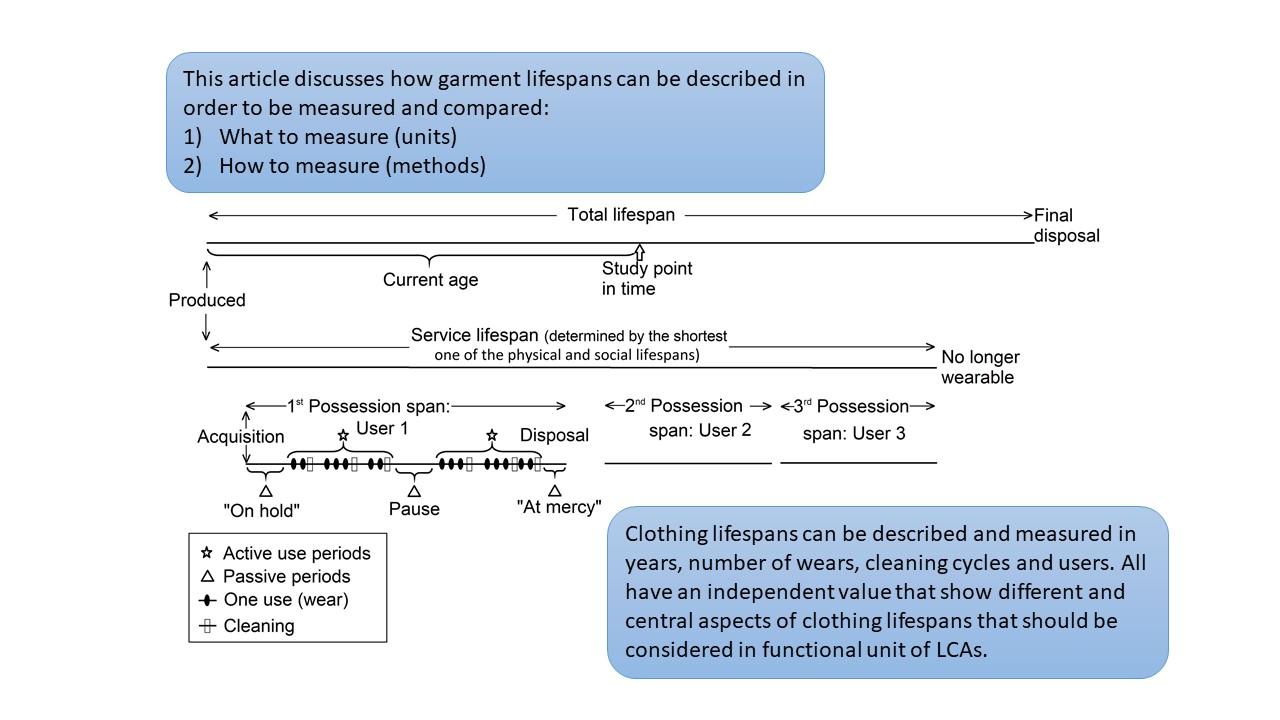
Increasing the use of each product, most often called longer lifespans, is an effective environmental strategy. This article discusses how garment lifespans can be described in order to be measured and compared. It answers two sub-questions: (1) what to measure (units), and (2) how to measure (methods). We introduce and define terms related to clothing lifespans and contribute to discussions about an appropriate functional unit for garments in life cycle assessments (LCA) and other environmental accounting tools. We use a global wardrobe survey to exemplify the units and methods.

Clothing lifespans can be described and measured in years, the number of wears, cleaning cycles, and users. All have an independent value that show different and central aspects of clothing lifespans. A functional unit for LCAs should emphasise both the number of wears for all users as well as the service lifespan in years. Number of wears is the best measure for regular clothing, while number of years is most suited for occasion wear, because it is important to account for the need of more garments to cover all the relevant occasions during a specified time period. It is possible to study lifespan via carefully constructed surveys, providing key data relating to actual garment use.

Environmental impacts associated with the production, use, and end-of-life of a woollen garment

The textiles industry is a substantial contributor to environmental impacts through the production, processing, use, and end-of-life of garments. Wool is a high value, natural, and renewable fibre that is used to produce a wide range of garments, from active leisure wear to formal wear, and represents a small segment of the global fashion industry. Woollen garments are produced by long, global value chains extending from the production of ‘greasy’ wool on sheep farms, through processing to garment make-up, retail, consumer use, and end-of-life. To date, there have been limited life cycle assessment (LCA) studies on the environmental impacts of the full supply chain or use phase of garments, with the majority of wool LCA studies focusing on a segment of the supply chain. This study aimed to address this knowledge gap via a cradle-to-grave LCA of a woollen garment.

Does Use Matter? Comparison of Environmental Impacts of Clothing Based on Fiber Type

Several tools have been developed to compare the environmental impact of textiles. The most widely used are Higg Materials Sustainability Index (MSI) and MADE-BY Fiber Benchmark. They use data from production to evaluate the environmental impacts of textiles differentiated by fiber type. The use phase is excluded from both tools. This article discusses whether there is evidence that the use of textiles differs systematically between different fiber types and examines the consequences of comparing the environmental impacts of clothing based on differences in production of fibers alone without including differences in their use.

The empirical material in this paper is based on analysis of rating tools and a literature review on clothing use. It shows that fiber content contributes to the way consumers take care of and use their clothing. When use is omitted, major environmental problems associated with this stage, such as spread of microplastics, are also excluded. This one-sided focus on material production impacts also excludes the importance of product lifespans, quality, and functionality. The consequence is that short-lived disposable products are equated with durable products. Comparing dissimilar garments will not help consumers to make choices that will reduce the environmental burden of clothing. We need an informed discussion on how to use all materials in the most environmentally sustainable way possible.

Use phase of apparel: A Literature review for Life Cycle Assessment with focus on wool.

  • by

This report presents a literature review of clothing use phase. The purpose is to support improved methodological development for accounting for the use phase in Life Cycle Assessment (LCA) of apparel. All relevant textile fibres are included in the review. However, the main focus is on wool. We ask whether the use of wool has different environmental impacts than clothes in other fibres. The report builds on a review of literature from the past 20 years. The review showed that clothing made from different materials are used, and reused in different ways. Wool is washed differently as it has about ten degrees lower washing temperature than the average laundry in Europe. Wool is also more likely to be either dry-cleaned or washed by hand than other textiles. Moreover, when dried, it is less likely to be tumble-dried.

When comparing the number of days between the washes of different types of clothes, we found that respondents were likely to use their woollen products about twice as long between washes compared to their equivalent cotton products. We also found that woollen products had a longer average lifespan and were more likely to be reused or recycled. There is a lot of research-based information available concerning the use and re-use of clothing, and we believe there are sufficient results available on which to base LCA studies. Furthermore, we believe that environmental tools that compare different fibres but exclude use phase provide misleading results. Including the use phase in fibre ranking benchmark tools will improve the rigour and accuracy of these tools for all fibres, compared to reporting results for fibre production only. However, we have also shown that there are several methodological, conceptual and empirical knowledge gaps in existing literature.
Wool as an Heirloom: How Natural Fibres Can Reinvent Value in Terms of Money, Life-Span and Love

  • by

This paper addresses a main challenge for natural fibres; falling prices and increased focus on quantity versus quality. This is a challenge not only related to economic issues and profit, but is also unsustainable in an environmental perspective and in light of the challenges the textile sector and the world face. The paper uses wool as an example and in a surprising approach links the history and century-old traditions of natural fibers to an environmental thinking which supplements the traditional thinking around circular economy and LCA. Fabrics with a long life are the ones that have the lowest environmental impact (Fletcher and Tham2015; Laitala2014). Longevity or lifespan is a complex phenomenon in which both technical and social, or aesthetic aspects, are intertwined.